

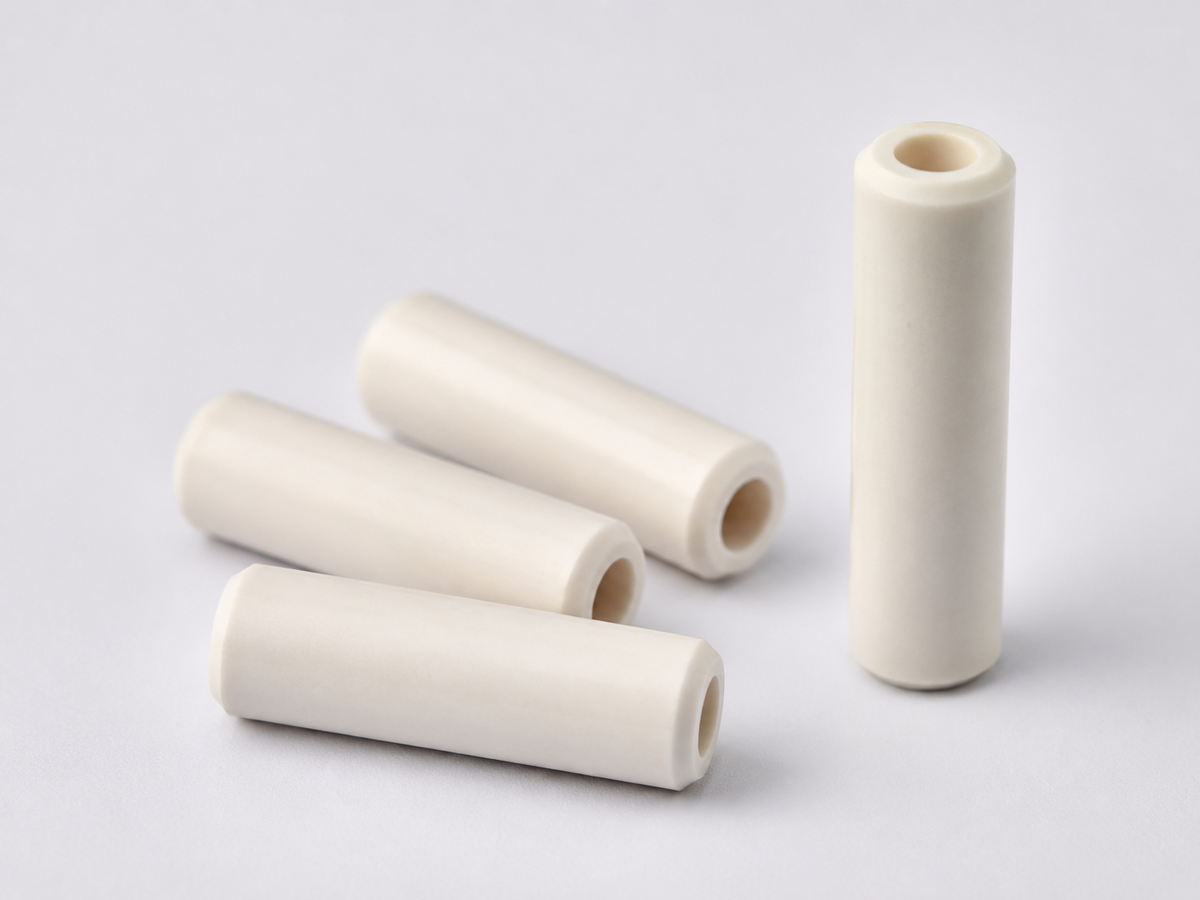
Electrical insulation becomes more challenging when components must operate under high temperatures, mechanical loads, or demanding industrial conditions. Conventional plastic insulators may soften, deform, or lose performance, while metallic components cannot provide electrical isolation.
This is why many equipment manufacturers turn to custom ceramic insulator manufacturers for components that combine electrical insulation with mechanical stability, heat resistance, and dimensional accuracy.
However, choosing the right ceramic material is only part of the process. Wall thickness, mounting features, surface finish, manufacturing tolerances, and operating conditions also influence how reliably an insulator performs.
This article explains how ceramic insulating parts are designed and manufactured, which materials are commonly used, and what engineers should consider when sourcing custom components.

What Are Custom Ceramic Insulators?
Custom ceramic insulators are engineered components designed to electrically isolate conductive parts while providing mechanical support or resistance to environmental conditions.
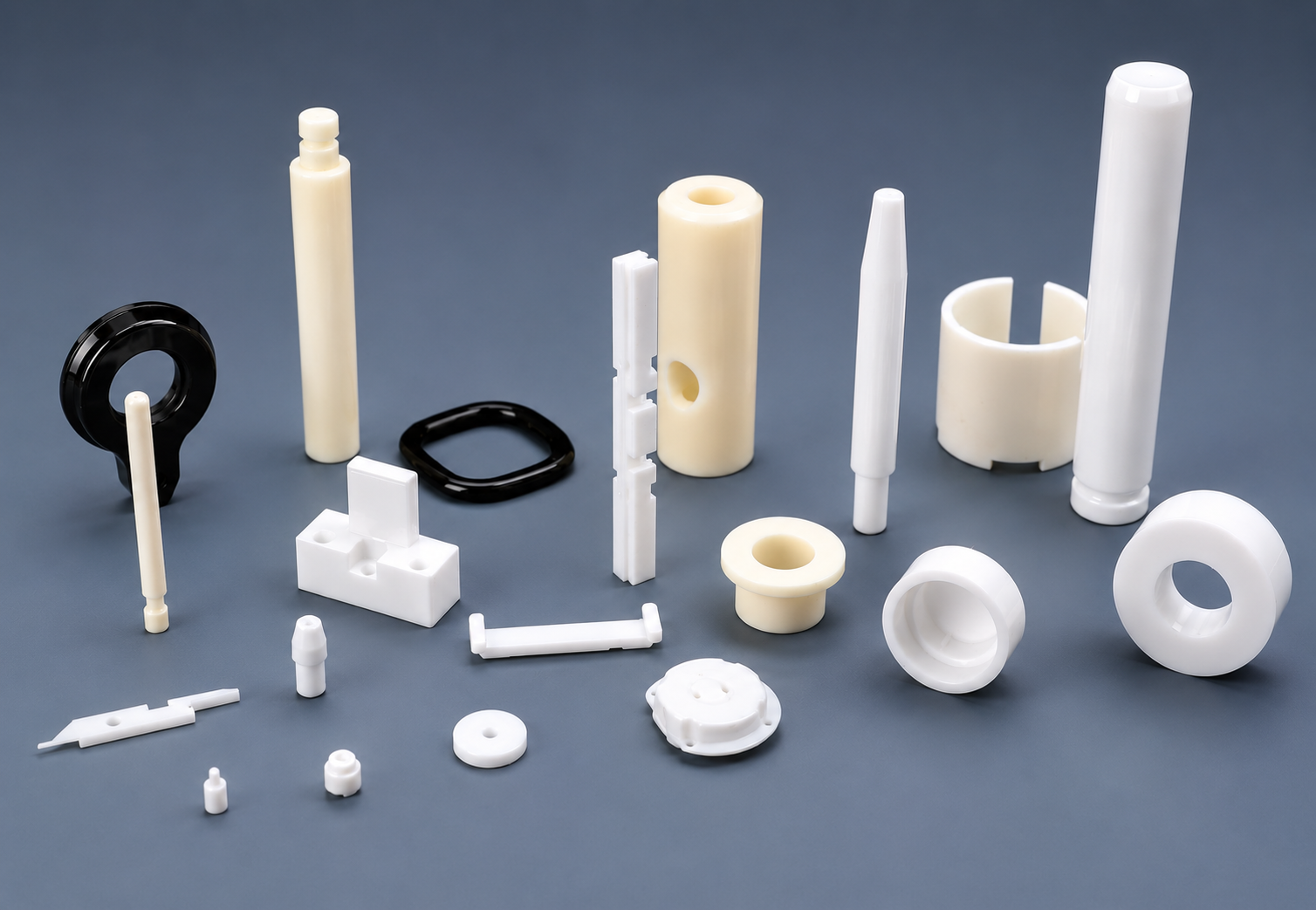
Unlike standard electrical insulators, custom ceramic components are manufactured to match specific equipment designs. They may include mounting holes, grooves, stepped diameters, precision bores, or other application-specific features.
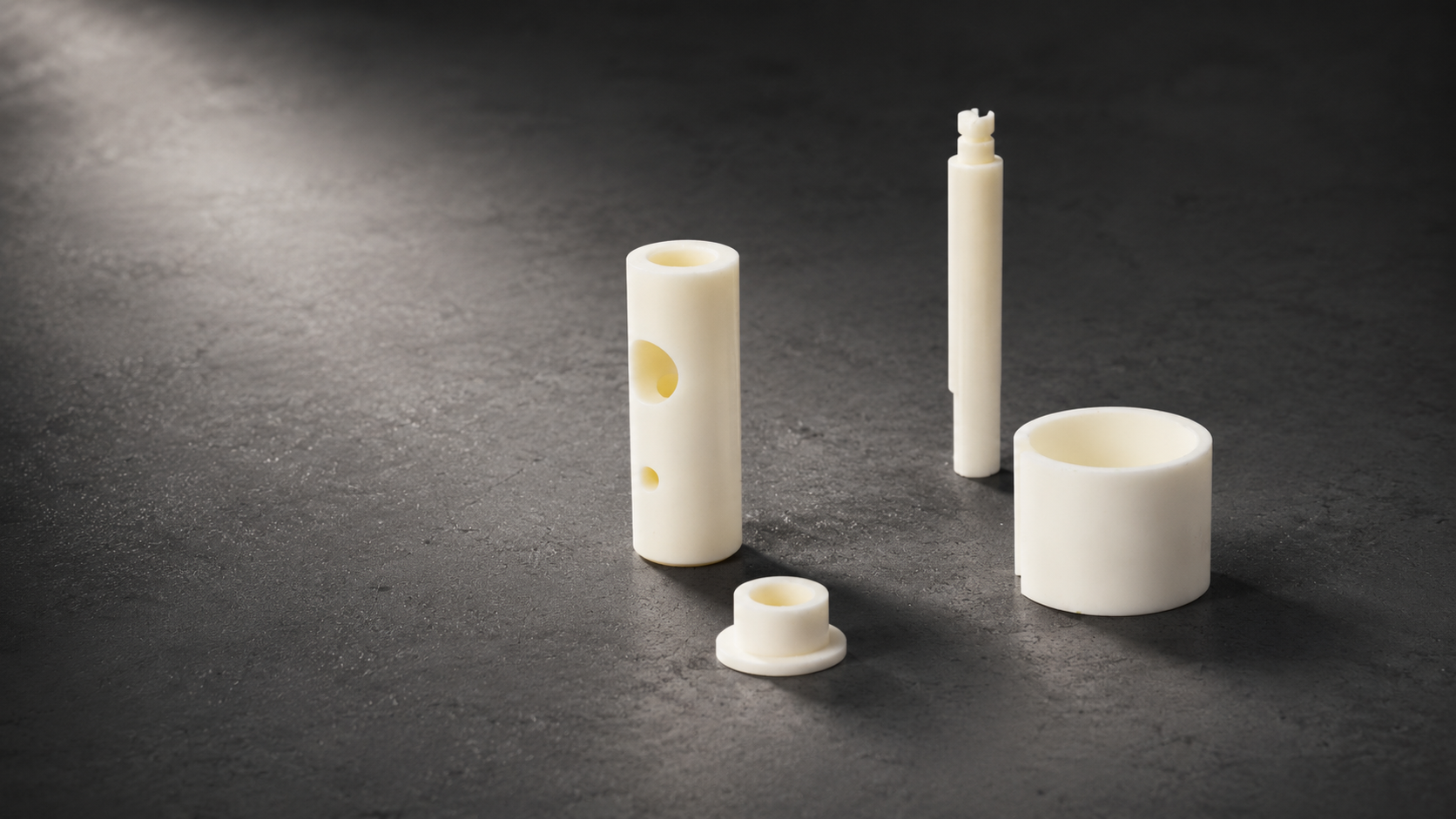
Typical products include ceramic insulating bushings, mounting spacers, feedthrough insulators, insulating sleeves, terminal supports, ceramic tubes, and high-temperature insulating components.
For many of these parts, electrical performance depends not only on the ceramic grade but also on the geometry and operating environment.
A ceramic insulator with insufficient wall thickness or an unsuitable surface design may fail electrically even when the material itself has excellent dielectric properties.
Which Materials Are Used for Ceramic Insulator Parts?
Material selection is one of the most important stages of ceramic insulator manufacturing.
Different ceramics provide different combinations of dielectric strength, thermal conductivity, mechanical strength, and resistance to temperature or chemical exposure.
|
Ceramic material |
Key characteristics |
Typical insulating applications |
|---|---|---|
|
Alumina (Al₂O₃) |
High electrical resistivity, hardness, heat resistance |
Bushings, spacers, tubes, feedthrough bodies |
|
Aluminum Nitride (AlN) |
Electrical insulation and high thermal conductivity |
Power electronics, thermal substrates |
|
Steatite |
Good electrical insulation and economical forming |
Terminal supports, electrical spacers |
|
Zirconia (ZrO₂) |
High strength and fracture toughness in suitable grades |
Mechanically loaded insulating components |
|
Silicon Nitride (Si₃N₄) |
Strong mechanical properties and thermal shock resistance |
Specialized electromechanical components |
Alumina Ceramic Insulators
Alumina is among the most widely used materials for industrial ceramic insulation.
It provides strong electrical insulation, high hardness, good dimensional stability, and resistance to elevated temperatures.
Common alumina grades include 95%, 96%, 99%, and 99.5%, although the most suitable grade depends on operating requirements.
Higher alumina purity may improve certain electrical, thermal, or chemical properties, but purity alone does not determine overall component performance.
Alumina insulators are frequently found in electrical equipment, industrial heating systems, measuring instruments, and semiconductor manufacturing equipment.

Aluminum Nitride Insulators
Aluminum nitride is particularly useful when an electrically insulating component must also conduct heat.
For example, a power electronics assembly may require electrical isolation between a heat-generating device and a cooling structure.
A suitable AlN component can provide an electrically insulating thermal path, reducing the conflict between heat dissipation and electrical isolation.
However, AlN generally costs more than common alumina grades and requires appropriate processing and environmental evaluation.
Steatite Ceramic Insulators
Steatite is another material used in electrical insulation applications.
It is often considered for electrical terminals, ceramic spacers, and components that require good dielectric performance without the advanced mechanical or thermal properties of higher-performance ceramics.
For some high-volume applications, steatite can provide a cost-effective alternative to alumina.
The final choice depends on the required temperature rating, mechanical strength, component dimensions, and electrical specifications.

Important Design Considerations for Ceramic Insulator Parts
Designing a ceramic insulator requires attention to both electrical and mechanical requirements.
A component can meet its dimensional tolerances but still fail because of an unsuitable insulation path, excessive mechanical loading, or thermal stress.
Wall Thickness and Mechanical Strength
Ceramic insulators often contain holes, slots, and thin walls.
Although ceramics can have high compressive strength, they are generally much less tolerant of tensile stress, impact, or highly concentrated loads.
Very thin walls may chip during machining or crack during assembly.
Small corner radii and suitable support surfaces can help reduce stress concentrations.
Thermal Expansion and Metal Assemblies
Many ceramic insulators are installed inside metal equipment.
Because metals and ceramics expand at different rates as temperature changes, rigid assemblies can create significant stresses.
This is particularly important when ceramic components are press-fitted, clamped, or bonded to metal structures.
A proper design should consider thermal expansion, operating temperature, fit conditions, and the method used to secure the ceramic part.
Surface Finish and Cleanliness
Surface condition can influence both electrical performance and component reliability.
For applications involving high voltage, vacuum equipment, or contamination-sensitive environments, surface cleanliness and processing residues should be reviewed.
A smoother surface is not automatically the best solution for every application. Surface finish should be specified according to the actual functional requirement.
Where Are Industrial Ceramic Insulators Used?
Ceramic insulating components are used in selected processing, positioning, and electrical isolation applications. Material purity, particle generation, and compatibility with process conditions may be critical.
Ceramic tubes, spacers, and terminal supports help separate electrically conductive heating elements from surrounding structures while operating at elevated temperatures.
Alumina and aluminum nitride insulating components can provide electrical isolation in power modules, thermal assemblies, and other electronic equipment.
Ceramic sleeves, spacers, and feedthrough components can support conductive elements while maintaining electrical isolation under suitable operating conditions.
What Determines the Cost of Custom Ceramic Insulators?
The price of a custom ceramic insulator is influenced by more than its dimensions.
Material selection, geometric complexity, quantity, manufacturing method, and inspection requirements all affect the final quotation.
For example, a simple alumina spacer with a central hole may be relatively economical to manufacture through conventional forming and finishing methods.
A more complex component with multiple precision bores, thin walls, and strict flatness requirements may require additional machining operations and specialized fixtures.
One of the most effective ways to control cost is to distinguish critical features from noncritical dimensions.
If an insulating spacer only requires a tight tolerance on its internal diameter and mounting face, applying the same precision requirements to every surface may add unnecessary manufacturing expense.
For projects with repeat production requirements, the manufacturer should also consider whether tooling investment can reduce the long-term unit cost.
How to Evaluate a Custom Ceramic Insulator Manufacturer
When sourcing ceramic insulators, buyers should evaluate whether the manufacturer understands the electrical and mechanical requirements of the finished component.
A supplier should be able to review drawings, discuss material options, identify difficult manufacturing features, and define the inspection method for critical dimensions.
|
Evaluation factor |
Questions to ask |
|---|---|
|
Material options |
Which ceramic grades are suitable for the application? |
|
Manufacturing process |
Is the part pressed, molded, extruded, or machined? |
|
Dimensional accuracy |
Which features require post-sinter grinding? |
|
Electrical requirements |
What insulating properties need verification? |
|
Quality control |
How are dimensions and visual defects inspected? |
|
Prototypes and production |
Can the manufacturing method support the required quantity? |
For demanding applications, buyers should also establish whether material certificates, electrical testing, or other documented quality requirements are necessary.
The most reliable approach is to review these requirements before production begins rather than discovering differences in expectations during final inspection.
Custom Ceramic Insulator Manufacturing Support from XY-GLOBAL
XY-GLOBAL works with customers developing custom precision components for industrial equipment, electronics, automation, and other engineering applications.
For ceramic insulator projects, we can review component drawings, material requirements, dimensional features, and assembly conditions to evaluate suitable manufacturing options.
Our broader experience in precision machining, component manufacturing, and assembly also helps when ceramic insulators must fit accurately with metal parts or other mechanical components.
We understand that an insulating component is rarely used independently. It normally forms part of a larger assembly where mounting accuracy, mechanical loading, and operating temperature can directly affect reliability.
By reviewing these factors at an early stage, we aim to help customers identify practical material and manufacturing solutions.
Material availability, specific processing capabilities, inspection requirements, and delivery schedules are confirmed according to the project.
Frequently Asked Questions
Can ceramic insulators be manufactured according to customer drawings?
Yes. Custom ceramic insulators can be produced from technical drawings or 3D models, subject to material and manufacturing feasibility. Critical dimensions, quantity, and operating conditions should be supplied for quotation.
Are alumina ceramic insulators suitable for high-voltage applications?
Alumina can be suitable for high-voltage insulation, but the actual voltage rating depends on component geometry, material grade, electrical clearance, creepage distance, surface condition, and environmental conditions. The complete design requires verification.
Can ceramic insulators be used in vacuum equipment?
Selected technical ceramics are used in vacuum applications. However, suitability depends on material composition, porosity, cleanliness, joining methods, and the vacuum conditions involved.
Do custom ceramic insulators require tooling?
Not always. Simple prototypes may be machined from suitable ceramic stock, while repeat production or complex designs may benefit from dedicated forming tools. The best option depends on component geometry and production quantity.
Get a Quote for Custom Ceramic Insulator Parts
If your project requires custom alumina insulators, ceramic bushings, insulating sleeves, precision spacers, or other technical ceramic components, XY-GLOBAL can review your requirements and discuss suitable manufacturing options.
Send us your 2D drawings or 3D CAD files, together with the required material, quantity, and application details.
Contact XY-GLOBAL: Visit XY-GLOBAL

공유:
MIM Molding | Custom Metal Injection Molding Services