

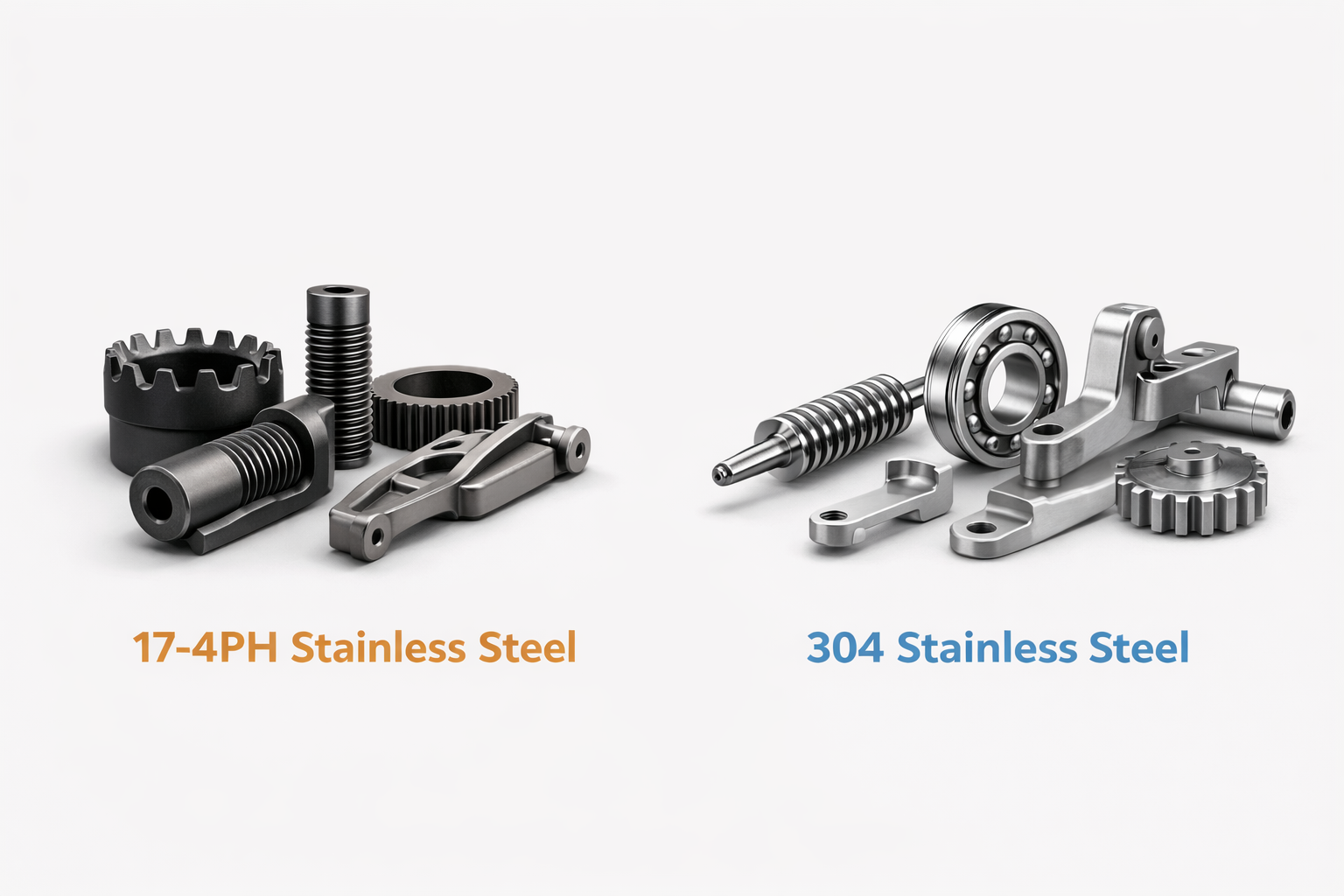
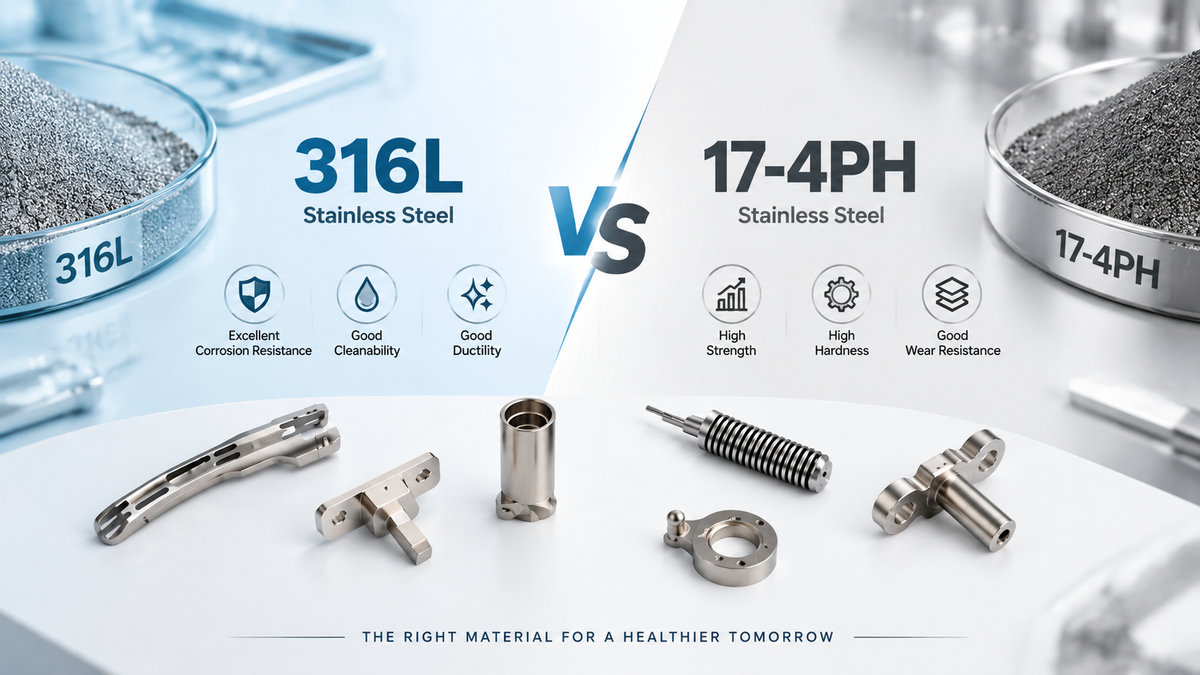
17-4 PH and 304 are the two most popular stainless steels used in Metal Injection Molding (MIM). 17-4 PH is famous for being very strong and hard, making it the top choice for heavy-duty precision parts. 304 is a must-have for everyday parts because it doesn’t rust easily and is very tough.
If you’re trying to choose between these two mim materials, this guide will explain the main differences in plain language to help you pick the right material for your MIM project.

Why Material Choice Matters More in MIM
With machined parts, designers sometimes start with a material they already know and then cut the geometry around it, but MIM works differently. Because MIM is usually selected for small, complex metal parts with fine features produced in medium to high volumes—especially those that would be too expensive to machine individually—the choice of material is tied directly to the manufacturing process itself. This means the material you choose impacts sintering behavior, shrinkage control, and final density, as well as the heat treatment route and surface finish.
So the 17-4 stainless steel vs 304 decision in MIM is not just about a datasheet. It affects how the part is made, how stable it is after sintering, what secondary operations may be needed, and how it performs in service. In other words, for MIM parts, material choice is part design choice.

What 304 Stainless Steel Really Means in MIM
304 is an austenitic stainless steel. In practice, it is the “general-purpose stainless” many people already know.
For MIM parts, 304 is often chosen because it offers:
-
solid corrosion resistance in many common environments
-
good toughness
-
good appearance after finishing
-
a familiar stainless grade that is easy for customers to recognize
-
enough performance for many non-heavy-load components
The following table outlines the ideal use cases for 304 stainless steel versus its mechanical limitations.
| Where 304 Works Well | Where 304 Starts to Fall Short |
| Sleeves, Covers, & Housings | High strength |
| Connectors & Fittings | High hardness |
| General medical hardware | Strong wear resistance |
| Parts exposed to moisture | Stable performance under repeated mechanical loading |
| Parts not under heavy stress | Heavy stress |
What 17-4PH Really Means in MIM
17-4PH is a precipitation-hardening stainless steel. The key point is that it can be heat treated to achieve much higher strength and hardness than 304. That makes it one of the most common performance-driven stainless materials in MIM.
Where 17-4PH works well
17-4PH is often chosen for:
-
structural precision parts
-
locking features
-
wear-prone small mechanisms
-
medical instrument components
-
actuator parts
-
brackets with load
-
parts needing better edge or feature stability
Why it is attractive in MIM
MIM is often used when a small part has complex geometry but still needs real mechanical performance. That is where 17-4PH becomes very useful. It gives designers more confidence when the part is not only intricate, but also functional.
To distinguish 304 vs 17-4 stainless steel more clearly, please refer to the summary below:
| Property | 304 Stainless Steel | 17-4PH Stainless Steel |
| Stainless family | Austenitic | Precipitation-hardening |
| Strength | Moderate | High |
| Hardness | Lower | Higher |
| Heat treatable | No practical hardening route like 17-4PH | Yes |
| Wear resistance | Moderate | Better |
| Corrosion resistance | Very good in many common environments | Good to very good, but application-dependent |
| Toughness | Good | Good |
| Magnetism | Usually low | Usually magnetic |
| Typical MIM use | General corrosion-resistant parts | Functional high-strength parts |
Strength and Hardness: The Biggest Difference
This is the clearest dividing line in the 17-4 stainless steel vs 304 comparison. 304 is fine when the part is lightly loaded or mainly serves as a housing, sleeve, or support feature.
17-4PH is the better fit when the part must:
-
hold shape under load
-
resist bending or deformation
-
survive repeated use
-
keep sharp or small functional features intact
-
resist indentation or mechanical wear
Simply put, 304 is usually not chosen because it is strong enough for hard-working parts. 17-4PH often is. For a simple comparison:
-
304 is a reliable stainless for many general parts
-
17-4PH is the stainless you choose when the part is expected to work harder
That is why so many functional MIM parts end up on the 17-4 ph stainless steel vs 304 side of the decision.
Corrosion Resistance: Where 304 Often Feels Safer
Many people assume 17-4PH must be “better overall” because it is stronger. But when the main concern is corrosion, 304 vs 17 4 stainless steel can go the other way.
304 has a long reputation as a corrosion-resistant stainless for general service. In many applications, that makes it the safer and easier answer when the part:
-
is exposed to humidity
-
sees routine washing or cleaning
-
is not highly loaded
-
needs stable, familiar stainless performance
-
is selected more for environmental resistance than for strength
17-4PH also offers good corrosion resistance, but the real reason people pick it is usually not corrosion first. It is mechanical performance first.
So if the part is mostly fighting the environment rather than fighting load, 17-4 vs 304 stainless steel may favor 304.
MIM-Specific Performance: Why This Is Not the Same as Bar Stock Selection
This part matters, because many articles miss it.
Comparing 17-4PH and 304 in MIM is not exactly the same as comparing them in machined bar stock. In MIM, the final part is influenced by:
-
powder characteristics
-
binder system
-
debinding route
-
sintering profile
-
part geometry
-
wall thickness variation
-
post-sinter heat treatment
That means the real question is not just “Which alloy is better?”
It is also “Which alloy is better for this MIM geometry and this production route?”
In practical terms:
-
304 is often attractive when the design is complex but the mechanical demand is moderate.
-
17-4PH is often attractive when the design is complex and the part still has to perform like a real mechanical component.
That is one reason 17-4 ph stainless steel vs 304 comes up so often in MIM projects for medical devices, industrial mechanisms, and precision consumer products.
Typical MIM Applications: Which Material Fits Better?
304 is often better for:
-
corrosion-resistant housings
-
sleeves and collars
-
cosmetic metal parts
-
low-load connectors
-
general-purpose stainless fittings
-
parts that need stainless appearance without high stress
17-4PH is often better for:
-
trigger or locking components
-
gear-like precision parts
-
wear-contact elements
-
clamps and latches
-
actuator parts
-
structural inserts
-
medical tool components that carry force
This is where the 17 4 stainless steel vs 304 decision becomes less abstract. If the part is there to hold, engage, support, lock, or move, 17-4PH is often the better bet. If the part is there to resist corrosion and maintain shape without heavy load, 304 may be enough.
Medical and Industrial MIM: How the Choice Usually Plays Out
Medical components
In medical MIM parts, the decision often depends on whether the part is:
-
a structural or functional device component
-
a general stainless support or housing piece
Small jaws, clips, locks, instrument internals, and mechanism parts often lean toward 17-4PH because they need more strength and hardness. Parts that mainly need corrosion resistance and good stainless behavior may lean toward 304.
Industrial components
For industrial MIM parts, 17-4PH is often chosen when the part sees repeated motion, friction, clamping force, or assembly stress. 304 works better when the environment is more important than the load.
So in both medical and industrial contexts, 304 vs 17-4 stainless steel usually comes down to this:
-
Environment-driven part → 304
-
Mechanically driven part → 17-4PH
Wear Resistance and Feature Stability
This point is often underexplained, but it matters a lot in MIM.
MIM is commonly used for parts with:
-
small teeth
-
fine slots
-
thin tabs
-
precise hooks
-
detailed engagement surfaces
Those features can wear, round off, deform, or lose accuracy over time if the material is too soft.
That is another reason 17-4 stainless steel vs 304 often favors 17-4PH in functional assemblies. Higher hardness usually means better resistance to feature damage in service.
304 is still useful, but if the part has small functional geometry doing real work, 17-4PH usually gives more confidence.
Magnetism, Finishing, and Secondary Operations
These points are not always deal-breakers, but they can matter.
Magnetism
-
304 is generally low-magnetic in many conditions
-
17-4PH is usually magnetic
If the application is sensitive to magnetic behavior, this should be checked early.
Finishing
Both materials can be finished well, but appearance requirements, passivation, polishing, and surface condition should be reviewed based on end use.
Secondary operations
If the part needs machining after sintering, thread finishing, grinding, or other secondary work, material choice can influence processing ease and cost.
This is why the 17-4 ph stainless steel vs 304 decision should not be made by looking at corrosion and strength only.
Cost: Not Just Raw Material Cost
It is easy to assume 304 is the low-cost answer and 17-4PH is the expensive answer. Sometimes that is true, but not always in the way buyers think.
304 may reduce cost because:
-
it can avoid extra heat treatment complexity
-
it is enough for simpler part functions
-
it is easier to justify when high strength is unnecessary
17-4PH may increase cost because:
-
heat treatment is part of the value
-
property control matters more
-
process consistency may need tighter control
But if 304 forces the design to become thicker, less efficient, or less reliable, then the part may stop being the cheaper solution.
So when evaluating 304 vs 17-4 stainless steel, the smarter question is not “Which alloy is cheaper?” It is “Which alloy gives the lower total cost for a part that actually works?”
How to Choose Between 17-4PH and 304 for a MIM Part
If you are deciding between 17-4 vs 304 stainless steel, this checklist usually helps.
Choose 17-4PH if the part needs:
-
high strength
-
higher hardness
-
better wear resistance
-
better feature retention
-
better performance in moving or locking assemblies
-
heat-treatable stainless performance
Choose 304 if the part needs:
-
general corrosion resistance
-
good toughness
-
reliable stainless behavior in mild environments
-
no high structural demand
-
a simpler stainless solution for non-heavy-load parts
And if the answer is still unclear, ask this: Will the part fail because of rust, or because of deformation, wear, or insufficient strength?
That question usually points to the right material faster than a long datasheet review.
If you are reviewing a new stainless MIM component, XY-GLOBAL can help evaluate geometry, material route, and production feasibility early, so the part is set up for both performance and manufacturability from the beginning.
Share:
Ceramic Injection Molding Materials : How to Choose the Right Material
A Complete Guide to Tungsten Carbide MIM Parts