


Metal Injection Molding (MIM) is a near-net-shape manufacturing process that combines fine metal powders with a binder system, followed by injection molding, debinding, and sintering to produce finished metal components. It is widely used for small, complex, and high-precision parts that are difficult or costly to make by conventional machining or casting.

As demand grows in consumer electronics, medical devices, automotive, hardware, and industrial applications, MIM continues to gain attention for its ability to combine complex geometry, high material utilization, and volume production efficiency.
Why MIM Is Used
Compared with traditional manufacturing methods, MIM offers several practical advantages for precision metal parts.
| Advantage | Description |
|---|---|
| Complex geometry | Suitable for thin walls, small features, internal channels, and intricate shapes |
| High precision | Better dimensional consistency than many conventional casting routes |
| Good surface finish | Helps reduce secondary finishing requirements |
| High density | Uniform microstructure supports strong mechanical performance |
| High material utilization | Material usage can approach nearly 100% |
| Volume efficiency | Well suited for medium to high volume production |
| Broad material range | Compatible with stainless steel, titanium, tungsten alloys, hard materials, and more |
Common MIM Material Systems
One of the key strengths of MIM is its broad material compatibility. In principle, most powders that can be sintered at high temperature can be considered for MIM.

1. Iron-Based Alloys
Iron-based materials are the most widely used in MIM. They include stainless steel, low-alloy steel, tool steel, die steel, Fe-Ni magnetic alloys, and special alloys such as Invar and Kovar.
Common Stainless Steel Grades in MIM
| Material | Main Features | Typical Applications |
|---|---|---|
| 304L | General corrosion resistance | Consumer electronics, structural parts |
| 316L | Better corrosion resistance | Medical devices, precision parts |
| 410L | Higher strength | Functional components |
| 420L | Higher hardness and wear resistance | Structural and wear parts |
| 440C | High hardness and durability | Cutting and wear-resistant parts |
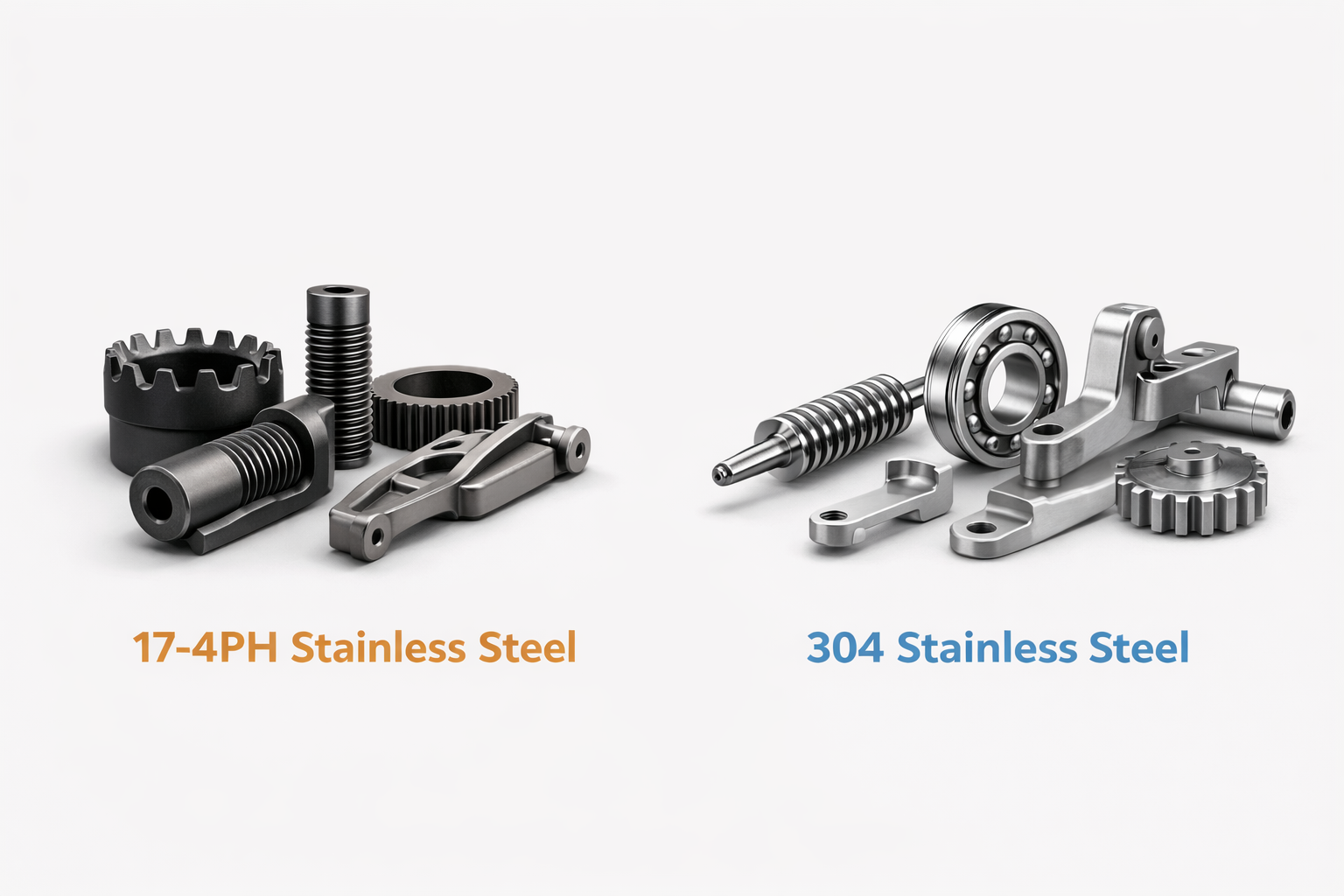
| 17-4PH | High strength after hardening | High-performance structural parts |
| 2507 | Strong corrosion resistance | Special environment applications |
Common Fe-Ni Alloys
| Material | Main Features | Typical Applications |
|---|---|---|
| Fe-2Ni | Magnetic performance | Functional internal parts |
| Fe-8Ni | Strength and magnetic properties | Structural components |
| Fe-50Ni | Higher magnetic characteristics | Electronic and precision functional parts |
2. Titanium and Titanium Alloys
Titanium and titanium alloys are valued for their light weight, high strength, corrosion resistance, and biocompatibility. They are increasingly used in smart wearables, medical devices, and implantable components.
The most common titanium materials in MIM are:
- Commercially Pure Titanium (CP-Ti)
- Ti-6Al-4V (TC4)
| Material | Main Features | Typical Applications |
|---|---|---|
| CP-Ti | Excellent corrosion resistance, biocompatibility | Medical instruments, implants |
| Ti-6Al-4V | High strength-to-weight ratio, strong mechanical performance | Wearables, medical parts, 3C structural components |
Titanium is difficult to machine using conventional methods because of its high melting point, hardness, and poor cutting performance. For this reason, MIM is an attractive route for producing small and complex titanium parts with less material waste.
3. Tungsten Alloys
Tungsten alloys are known for their high density, high melting point, wear resistance, corrosion resistance, and radiation shielding performance. They are used in medical, aerospace, defense, and electronics applications.
| Material System | Main Features | Typical Applications |
|---|---|---|
| W-Ni-Fe | High density, high temperature resistance | Aerospace, shielding components |
| W-Ni-Cu | Radiation shielding, dimensional stability | Medical shielding parts |
| W-Cu | Heat resistance and conductivity | Electrodes, electronic components |
Tungsten-based materials are also used in X-ray and CT shielding, catheter markers, and high-temperature tooling.

4. Hard Materials
Hard materials such as cemented carbides and cermets are also suitable for MIM when high wear resistance and durability are required.
| Material | Main Features | Typical Applications |
|---|---|---|
| WC-Co | High hardness and wear resistance | Cutting tools, wear parts |
| Fe-TiC | Strong hardness and fracture resistance | Heavy-duty functional components |
These materials are often used in applications involving repeated wear, cutting, and high mechanical load.
5. Other Expanding MIM Materials
Beyond the material systems above, MIM is also being developed for:
- copper
- aluminum
- precious metals
- nickel
- nickel-based superalloys
- molybdenum
- molybdenum-copper alloys
These materials support expanding applications in high-performance and specialized industries.
Powder Selection Principles for MIM
Powder selection is critical in MIM because it affects both process stability and final part performance. The key factors are particle size, particle shape, and powder purity.
1. Particle Size
MIM requires much finer powder than conventional powder metallurgy in order to achieve high sintering density.
| Item | MIM | Conventional Powder Metallurgy |
|---|---|---|
| Typical powder size | 0–25 μm | Above 40 μm |
| Sintering driving force | Higher | Lower |
| Surface finish | Better | More limited |
| Material cost | Higher | Lower |
2. Powder Shape
Powder morphology affects feedstock flow, injection behavior, and green part strength.
| Powder Shape | Advantages | Limitations |
|---|---|---|
| Spherical | Better flowability, lower viscosity, easier mold filling | Lower green strength, higher deformation risk during debinding |
| Irregular | Stronger particle interlocking, better green strength | Lower flowability |
In practice, powders with good dispersion, low agglomeration, and mainly spherical or near-equiaxed morphology are generally preferred.
3. Powder Purity
Powder purity has a direct effect on sintering behavior and final material performance. This is especially important for sensitive materials such as titanium, titanium alloys, aluminum, and NdFeB-based systems.
| Control Factor | Influence |
|---|---|
| Oxygen content | Affects sintering, mechanical properties, and physical performance |
| Carbon content | Influences microstructure stability |
| Other impurities | May reduce material consistency and final properties |
For reliable MIM production, powders should have high purity and low oxygen content.

Key Considerations for MIM Material Selection
Choosing a MIM material is not only about whether a powder can be molded. It also depends on whether the material matches the part structure, performance target, and production plan.
| Selection Factor | Main Concern |
|---|---|
| Material properties | Strength, corrosion resistance, wear resistance, density, magnetism, biocompatibility |
| Process compatibility | Powder size, sintering behavior, debinding stability |
| Part geometry | Complexity, thin walls, miniaturization |
| Project needs | Volume, cost, performance, appearance |
| Secondary operations | Heat treatment, machining, surface finishing |
Conclusion
MIM is not only a process for making complex metal parts. It is also a manufacturing route that depends heavily on the right combination of material system, powder characteristics, and process control.
From stainless steel and titanium alloys to tungsten alloys and hard materials, the range of Metal Injection Molding materials continues to expand. For applications that demand small size, complex geometry, high performance, and repeatable volume production, careful material selection is a key step in achieving stable and successful MIM results.




Share:
How MIM Can Reduce Manufacturing Cost for Complex Parts
2026 Top 10 Metal Injection Molding Companies: Global Guide