

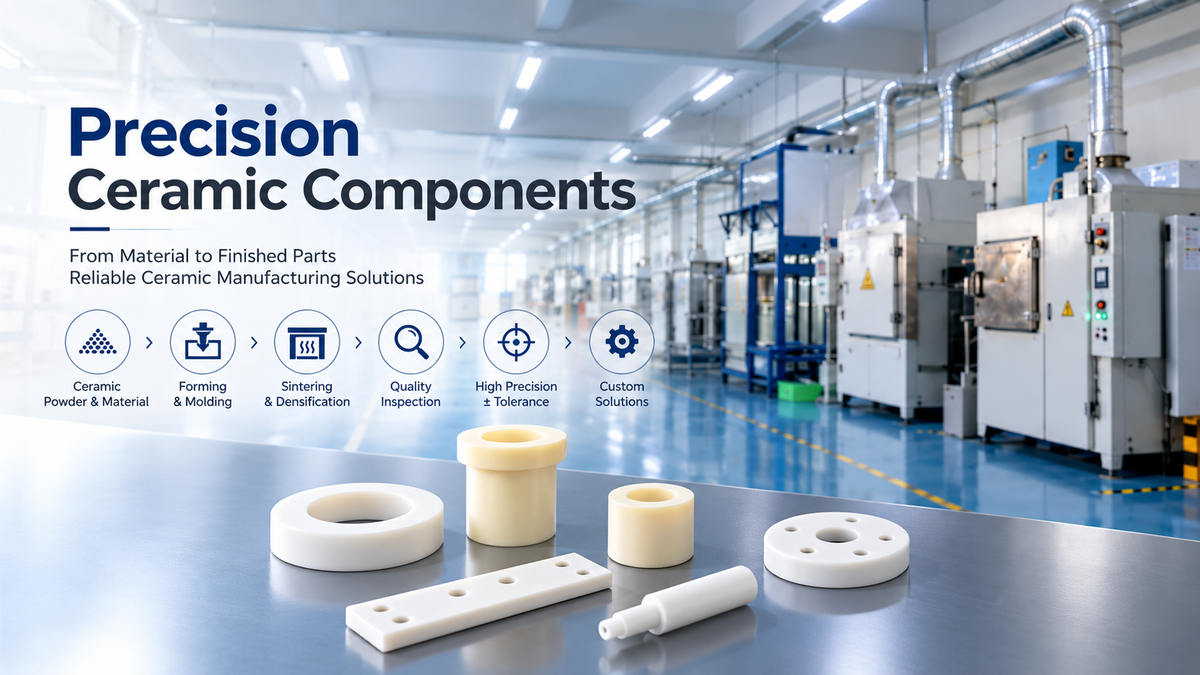
Have you ever had a metal ring wear out within months in abrasive fluids, or a plastic insulator deform under high temperatures? Precision parts made of ceramic can avoid problems like these. They can resist wear, insulate electricity, survive high temperatures, resist chemicals, or keep a stable shape over time.
As a trusted global custom precision parts manufacturer founded in 2010, XY-GLOBAL has made custom precision ceramic components one of our key specialties.
Drawing from years of hands-on manufacturing expertise, this complete guide covers everything you need to know about precision ceramic parts—including common types and materials, primary applications, manufacturing processes, and key design considerations for your custom parts. Send us your drawings for custom precision ceramic parts, and our engineering team will get right to work.

What Are Precision Ceramic Components?
Let’s start with the basic idea.
A precision ceramic component is a ceramic part made for a function. It might carry an electrical signal, guide a moving part, seal a fluid, resist abrasion, or operate in a hot environment. Its shape, material, tolerances, and surface finish all exist to support that function.
Think about a pump. Inside it, you may find ceramic shafts, sleeves, seal faces, or plungers. These parts see friction, pressure, and sometimes aggressive fluids. A metal part can work, but it may wear out or corrode. A ceramic part may last longer because it is hard, stable, and resistant to many chemicals.
That does not mean ceramic is always better. It means ceramic can be the better choice when the application demands properties that metals and plastics cannot provide at the same time.
Here is the thing: “precision” does not always mean every dimension needs to be extremely tight. It means the important features are controlled well enough for the part to work reliably in its assembly.
Common Types of Precision Ceramic Parts
Precision ceramic parts come in many forms. Some are simple rods, tubes, or plates. Others are complex components with holes, slots, thin walls, or irregular shapes.
Common examples include:
-
Ceramic insulators and electronic substrates
-
Wear plates, guides, liners, and bushings
-
Seal faces, plungers, valve components, and pistons
-
Pump parts, nozzles, spray components, and metering parts
-
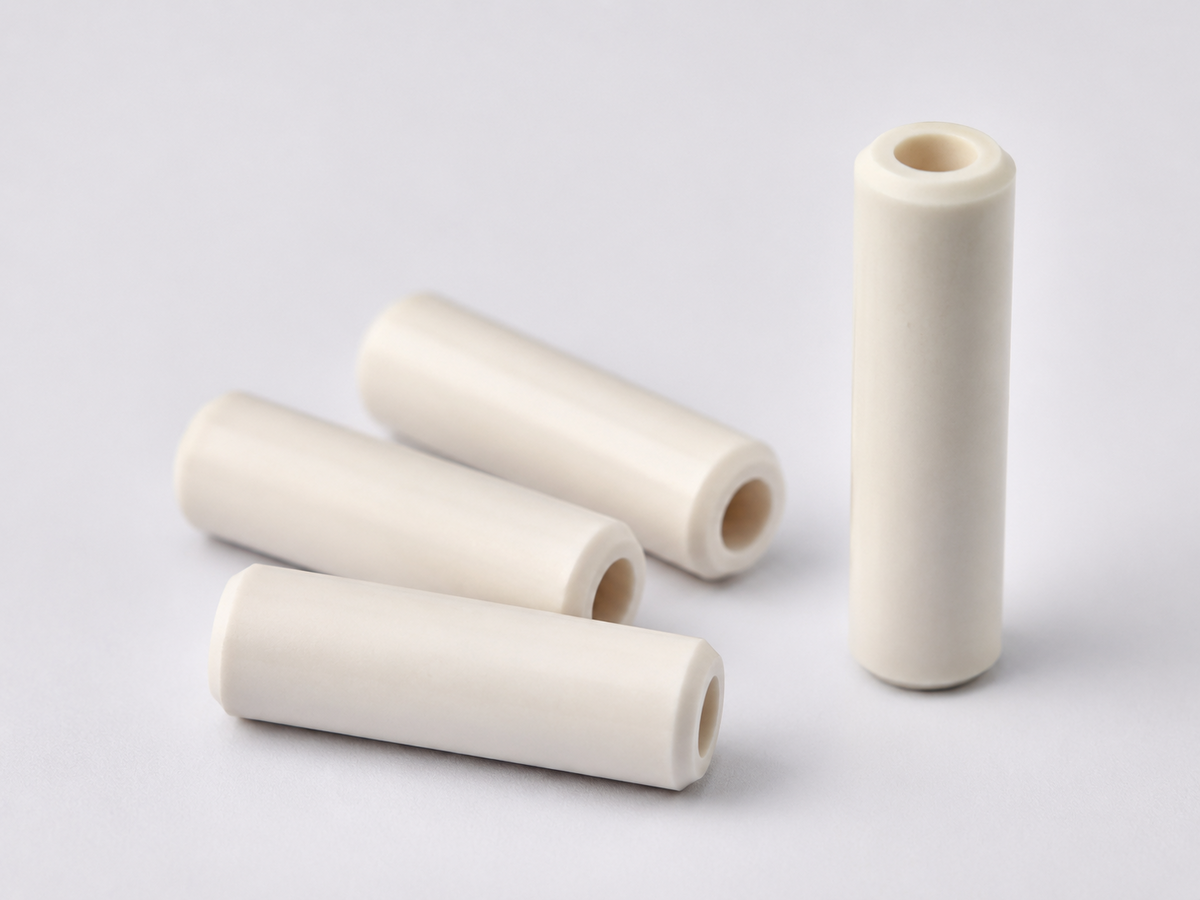
Ceramic rods, tubes, pins, washers, and custom blocks
-
Semiconductor equipment components
-
Medical and dental components
-
Sensor housings and electrical insulation parts
The exact type of ceramic part depends on what it needs to do. For example, a guide rail may mainly need wear resistance while an insulator may focus on electrical isolation.
Why Engineers Choose Ceramic Components
Ceramics are not always the right answer. But when they fit, they can solve problems that metals and plastics cannot.
Ceramic components are often chosen because they combine hardness, wear resistance, electrical insulation, corrosion resistance, and heat resistance in one material. Technical ceramics are widely used in electronics, medical devices, automotive systems, industrial machinery, and energy infrastructure.
Let’s look at a few common reasons.
Wear resistance
Ceramics are hard materials. In sliding, pumping, metering, or abrasive environments, a ceramic component can maintain its surface better than many metals.
This is why ceramic parts are used in seal faces, pump components, nozzles, guides, and wear plates. A ceramic surface may reduce wear and help a part keep its shape longer under abrasive conditions.
Electrical insulation
Many engineering ceramics are electrical insulators. This makes them useful in electronic assemblies, sensors, high-voltage equipment, and components that must isolate conductive parts.
Alumina is especially common in insulation-related applications because it combines good electrical insulation with mechanical stability and relatively accessible manufacturing options.
Heat resistance
Ceramics can keep their properties at temperatures where many plastics soften and some metals lose strength. This makes them valuable in heating equipment, industrial processes, automotive systems, and high-temperature assemblies.
Of course, “heat resistant” does not mean every ceramic can survive every thermal condition. Thermal shock, heating rate, cooling rate, and part geometry all matter.
Corrosion and chemical resistance
Ceramics can be a strong option when a part is exposed to aggressive chemicals, moisture, or corrosive media. This is one reason ceramic components appear in pumps, valves, seals, and fluid-handling equipment.
Still, the exact chemical environment matters. A material that works well in one fluid may not be suitable in another.
Lightweight design
Ceramics can offer high stiffness relative to their weight. In some applications, this helps reduce mass without giving up rigidity or wear performance.
But ceramics are brittle compared with metals. They do not bend much before breaking. That means designers need to avoid sharp corners, sudden section changes, and high local stress whenever possible.
Common Ceramic Materials
Choosing the material is usually one of the first decisions to produce precision ceramic components. It affects performance, cost, manufacturability, tolerances, and finishing options.
There are many engineering ceramics, but a few materials come up again and again.
| Material | Density (g/cm³) | Flexural strength (MPa) | Thermal conductivity (W/m·K) | Max use temperature (°C, air) | Key strengths | Typical applications |
| Alumina (Al2O3) | 3.75–3.95 | 250–400 | 20–35 | 1,400–1,600+ | Hard, wear-resistant, electrically insulating, cost-effective | Insulators, substrates, nozzles, pump parts, wear plates |
| Zirconia (ZrO2, Y-TZP) | 6.0–6.1 | 900–1,200 | 2–3 | 800–1,000 | Tough, smooth, wear-resistant | Plungers, valve components, seals, sleeves |
| Silicon carbide (SiC) | 3.10–3.20 | 400–600 | 120–160 | 1,600+ | Extremely hard, high thermal conductivity | Seal faces, nozzles, furnace parts, high-wear components |
| Silicon nitride (Si3N4) | 3.20–3.25 | 600–1,000 | 20–30 | 1,200–1,400 | Strong, tough, thermal-shock resistant | Bearings, rollers, high-load parts, engine components |
| Aluminum nitride (AlN) | 3.25–3.30 | 300–500 | 170–230 | 1,000+ | High thermal conductivity, electrical insulation | Heat sinks, power electronics, semiconductor fixtures |
| Boron nitride (BN) | 2.0–2.3 | 50–150 | 20–130 depending on grade | 900–1,000+ in inert/vacuum | Machinable, lubricious, thermal-shock resistant | Furnace fixtures, insulators, molten-metal handling |
Common Ceramic Materials
Choosing the material is usually one of the first decisions to produce precision ceramic components. It affects performance, cost, manufacturability, tolerances, and finishing options.
There are many engineering ceramics, but a few materials come up again and again.
Alumina ceramic
Alumina, also called aluminum oxide or Al2O3, is one of the most widely used technical ceramics. It is hard, electrically insulating, wear resistant, and chemically stable. It is also generally more accessible in terms of cost than many specialty ceramics.
Alumina ceramic parts are used in electrical insulators, substrates, wear components, pump parts, nozzles, and mechanical guides. If a part needs reliable insulation and abrasion resistance without moving to a more specialized material, alumina is often a practical starting point.
Zirconia ceramic
Zirconia, or zirconium dioxide (ZrO2), is known for its toughness. Compared with many other ceramics, it can handle bending stress and impact better, which makes it useful for parts that see repeated mechanical loading.
Zirconia ceramic components are often used for seals, sleeves, plungers, balls, gauges, and precision mechanical parts. They are also common in fluid-control and medical-related applications where a smooth, dense surface is important.
Zirconia is not automatically the best choice for every project. It can cost more than alumina, and its performance depends on the grade, stabilizer system, and manufacturing process.
Silicon nitride ceramic
Silicon nitride (Si3N4) is a high-performance ceramic with good strength, thermal shock resistance, and wear resistance. It is often used in demanding mechanical applications such as bearings, rollers, cutting tools, engine components, seal faces, and turbine-related parts.
If a component must handle high loads, repeated thermal changes, or harsh mechanical conditions, silicon nitride may be worth considering. It is generally more specialized and can be more expensive than alumina or zirconia.
Silicon carbide ceramic
Silicon carbide (SiC) is another advanced ceramic used where hardness, wear resistance, and high-temperature performance matter. It is often considered for mechanical seals, wear parts, nozzles, and high-temperature industrial applications.
Silicon carbide can be an excellent material, but it is usually harder to machine and finish than some oxide ceramics. That makes early design review even more important.
Boron nitride ceramic
Boron nitride (BN) is useful when a part needs electrical insulation, thermal stability, low friction, and machinability. It is often used in furnace fixtures, insulators, tubes, crucibles, and components that contact molten metal or glass.
BN can be machined more easily than many dense ceramics, and it offers good thermal-shock resistance. However, its mechanical strength is lower than alumina, zirconia, SiC, or Si3N4, so it is not usually the first choice for high-load structural parts.
Manufacturing Processes for Precision Ceramic Parts
There are several ways to make ceramic components. The best route depends on the part size, geometry, material, quantity, tolerance, and surface finish. Common manufacturing processes manily include:
Ceramic Injection Molding (CIM)
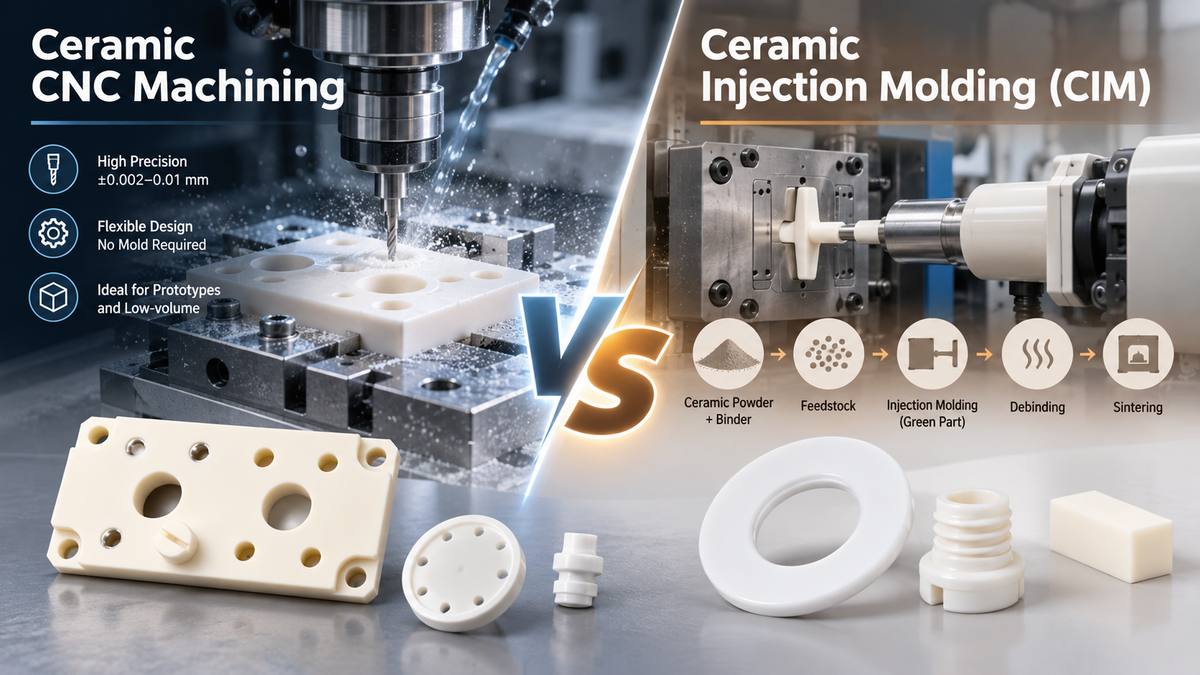
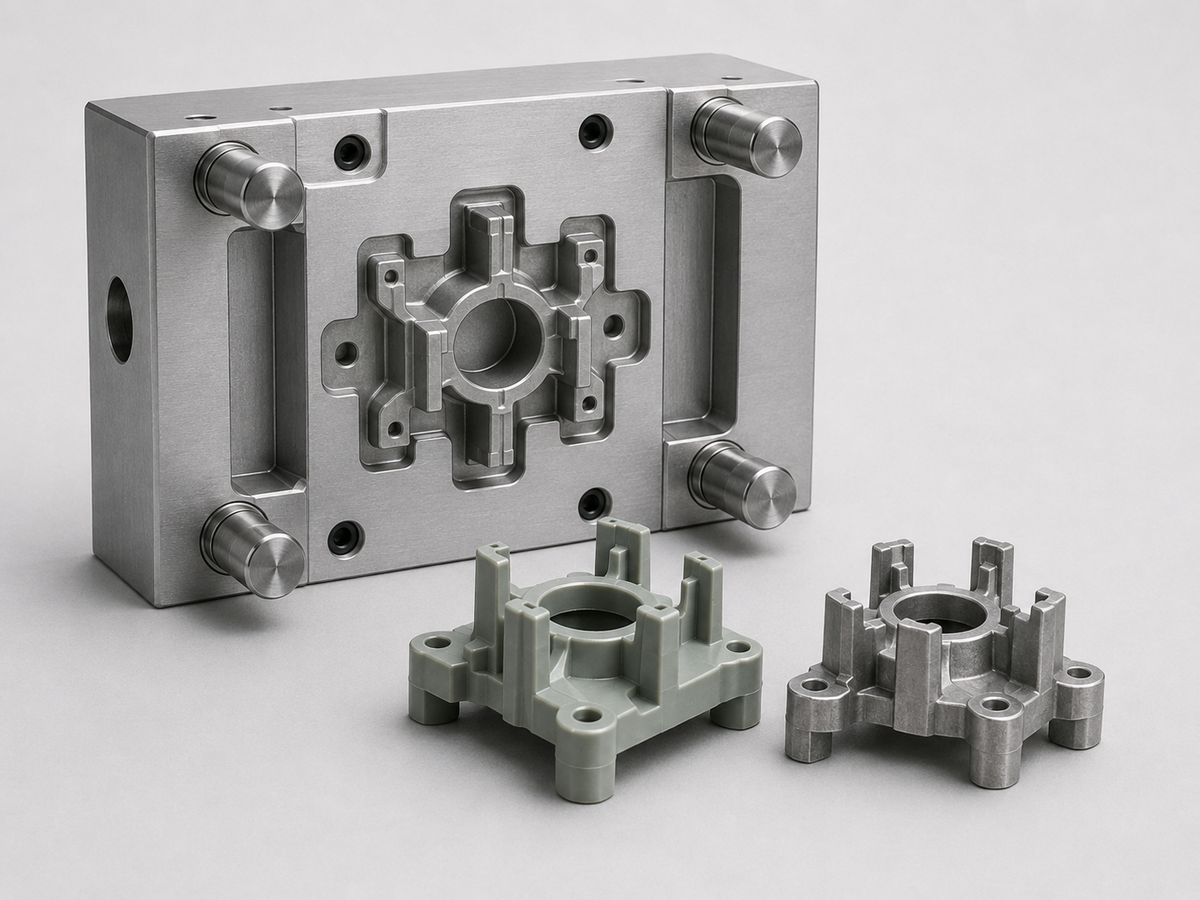
Ceramic Injection Molding, or CIM, is a near-net-shape manufacturing process used for small and complex ceramic components produced in medium to high volumes. It is similar to metal injection molding. It usually comes like this:
Ceramic powder is mixed with a binder to create a moldable feedstock, which is injected into a mold to form the part. The molded green part then goes through debinding and sintering to achieve its final ceramic properties.
CIM is particularly useful for precision ceramic components with complex profiles, thin sections, small holes, and features that would be expensive to machine individually.
Dry Pressing
Dry Pressing is a common ceramic forming process used for relatively simple parts produced in medium to high volumes.
Ceramic powder is placed into a rigid die and compacted under high pressure, then the green part is removed and sintered to achieve its final density and strength.
Dry pressing is suitable for ceramic discs, washers, insulators, substrates, and other parts with relatively simple geometry. It offers good production efficiency and dimensional consistency, but complex undercuts and highly detailed 3D features are difficult to form.

Cold Isostatic Pressing (CIP)
Cold Isostatic Pressing, or CIP, is used to produce ceramic blanks with more uniform density by applying pressure evenly from multiple directions.
Ceramic powder is placed inside a flexible mold and compacted under high fluid pressure. The pressed blank is then sintered and may require additional CNC machining or grinding.
CIP is commonly used for larger, thicker, or relatively simple ceramic parts where uniform material density is important. It is also a practical way to produce near-net-shape blanks for later precision machining.
Extrusion
Ceramic Extrusion is mainly used for ceramic parts with a continuous and consistent cross-sectional shape.
Ceramic material is prepared into a plastic feedstock and pushed through a shaped die, then cut to length, dried, and sintered.
Extrusion is well suited for ceramic tubes, rods, channels, honeycomb structures, and other long components. It is efficient for volume production, but parts with major changes in geometry usually require secondary machining.
Ceramic CNC Machining
Ceramic CNC Machining is used for precision ceramic parts that require complex geometry, tight tolerances, small production quantities, or features that are difficult to create through molding or pressing.
Ceramics can be machined in the green, partially sintered, or fully sintered condition. Fully sintered ceramics are extremely hard and usually require diamond tooling, grinding, and carefully controlled machining conditions.
Ceramic CNC machining is particularly suitable for prototypes, small-batch production, precision holes and bores, flat surfaces, complex profiles, and critical features that need to be finished after sintering.
What Affects Precision and Quality?
A precision ceramic part is not made good only at the final inspection stage. Quality is built through the whole process.
Powder consistency, feedstock preparation, molding parameters, debinding, sintering conditions, handling, and inspection all affect the final result. A small issue early in the process can later show up as warping, cracking, porosity, poor surface finish, or dimensional variation.
Material and powder consistency
The ceramic powder needs to be consistent in chemistry, particle size, and purity. If the powder changes from batch to batch, shrinkage and sintering behavior can change too.
This is why material traceability matters. A supplier should be able to connect a finished part back to its material batch, process records, and inspection results.
Part geometry
Geometry has a major effect on manufacturability. Uniform wall thickness, gradual transitions, proper radii, and realistic tolerances all help reduce distortion and cracking risk.
Thin sections, thick sections, deep blind holes, sharp corners, and large unsupported areas can create problems during molding, debinding, or sintering. Ceramic components benefit from designs that allow uniform shrinkage and stable support during sintering.
Sintering support
Some ceramic parts need support during sintering. This is especially true for parts with long overhangs, thin walls, or features that could sag under their own weight.
Sintering supports do not replace good tolerance planning. But they can help control flatness, straightness, datum stability, and assembly surfaces.
Inspection and documentation
Final inspection should check the features that matter. That may include critical dimensions, visual defects, density, surface roughness, hardness, or electrical properties.
For a custom project, inspection requirements should be defined before production begins. This avoids confusion later about which dimensions are critical, how they will be measured, and what documentation the customer will receive.
How to Assign Tolerances on a Ceramic Part Drawing
One of the most common mistakes in ceramic part design is applying tight tolerances to every dimension. In practice, this can add unnecessary grinding, inspection time, scrap risk, and cost.
A better approach is to separate critical functional dimensions from general dimensions.
Features related to sealing, alignment, locating, mating, movement, or controlled surface finish usually need tighter tolerances. Less critical areas can often remain within normal as-sintered variation.
Ceramic drawings commonly distinguish between as-sintered dimensions and precision-ground features. General geometry may be left as-sintered, while critical diameters, flat surfaces, locating holes, or sealing areas are finished by grinding, lapping, or polishing.
For example, an outer profile may only need an as-sintered tolerance, while a sealing diameter or locating hole may require precision grinding. A mating surface may need tighter flatness and surface roughness control.
The key is to apply tighter tolerances only where they directly affect part function. This keeps the ceramic part easier to manufacture, more stable in production, and more cost-effective.
Common DFM Mistakes
Ceramic parts fail for reasons that often could have been addressed earlier. Here are some common issues we see during drawing review.
Uneven wall thickness
A part with a very thin section connected to a thick section may shrink at different rates. That can lead to warping, internal stress, or cracking.
Where possible, use more uniform wall thickness. If a thick area is necessary, consider coring it out or using a gradual transition.
Sharp corners
Sharp internal corners concentrate stress. Ceramics do not handle stress concentration as well as metals.
Adding a radius may look like a small change, but it can make a big difference in manufacturability and long-term reliability.
Deep blind holes
Deep blind holes can be difficult to mold, debind, and sinter evenly. They may also trap binder or create uneven density.
If a deep hole is necessary, review the depth-to-diameter ratio and consider whether a through hole, split feature, or post-machining option is more practical.
Threads formed directly in ceramic
Forming threads directly in ceramic can be possible in some cases, but it is not always the best choice. Threads create complex mold features and may be vulnerable during handling or sintering.
For many applications, it is more reliable to use a metal insert, form a simplified feature, or machine and tap the thread after sintering.
Tight tolerances on non-critical surfaces
This is one of the most expensive mistakes. If a surface does not affect assembly or function, it usually does not need a precision-ground tolerance.
Keep non-critical dimensions practical. Save the tight tolerances for the features that truly matter.
XY-GLOBAL Rocks for Precision Ceramic Components
Founded in 2010, XY-GLOBAL is a on-demand high-precision ceramic part manufacturer, bringing over a decade of expertise in delivering precision ceramic components, from material selection to finishing, inspection, and final delivery.
Depending on the part geometry, quantity, tolerance, and application requirements, we can recommend the most suitable manufacturing process for your project, such ceramic injection molding (CIM), pressing, or ceramic CNC machining. We also work with a wide range of ceramic materials, including alumina, zirconia, silicon carbide, silicon nitride, aluminum nitride, cordierite, and other technical ceramic materials.
For critical features, we support precision holes, flat surfaces, controlled surface roughness, and tight dimensional requirements through secondary machining and finishing. We also focus on batch consistency, dimensional stability, traceability, and complete inspection documentation under ISO 9001 and ISO 13485 quality management systems.
We support both prototypes and volume production, with fast lead time depending on the ceramic material, part complexity, tolerance, quantity, and finishing requirements.
If you have a drawing for a custom ceramic part, send it to XY-GLOBAL along with your target material, annual volume, operating environment, and critical requirements. Our team can review the feasibility of your precision ceramic component and recommend a practical manufacturing process, finishing, and inspection plan.

Share:
Metal Injection Molding Cost Per Part: What Affects the Price?
Custom Metal Injection Molding Services for Precision Parts