

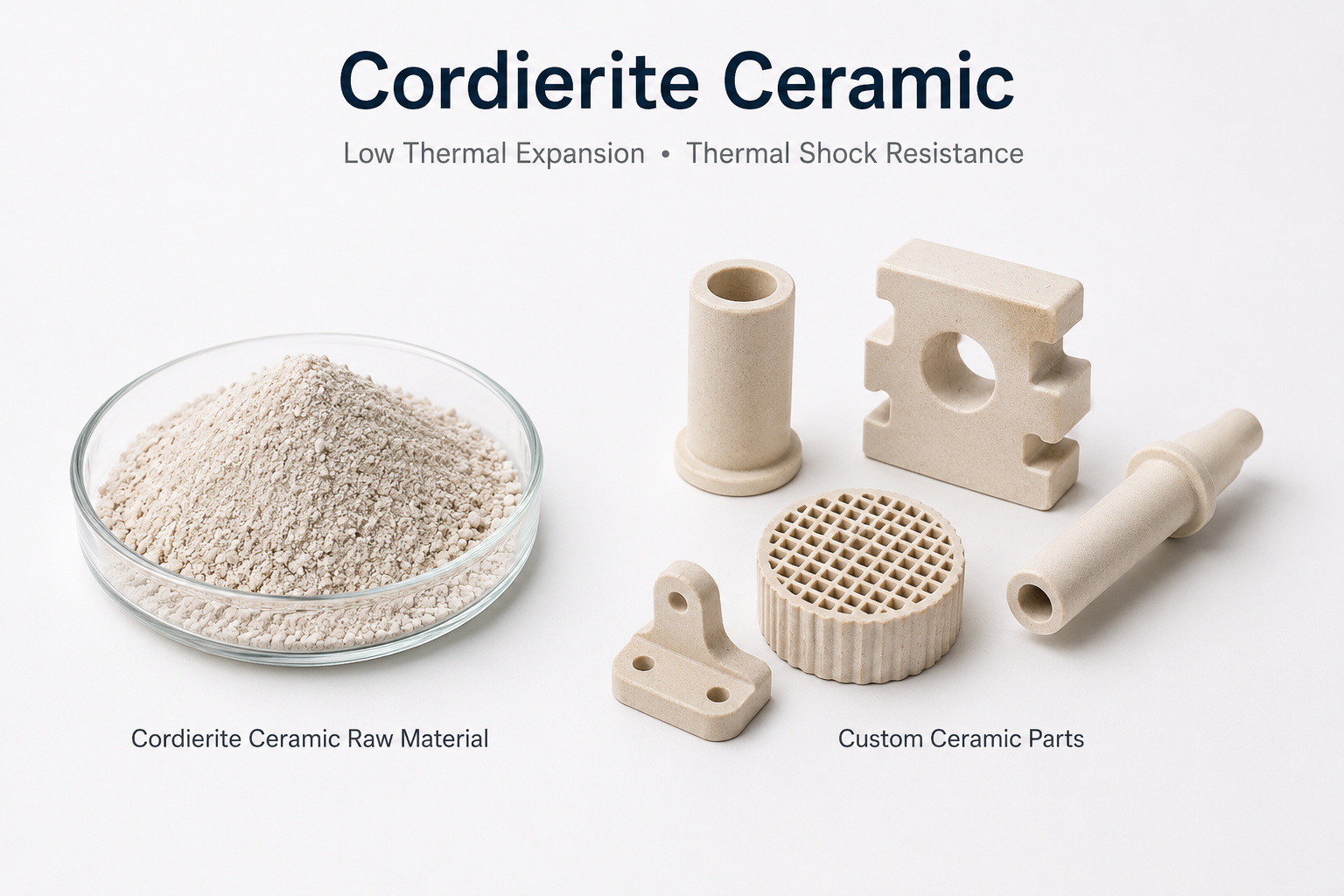
Cordierita para moldeo por inyección de cerámica
La cordierita es un material cerámico de silicato de magnesio y aluminio de baja expansión con excelente resistencia al choque térmico, buen aislamiento eléctrico y rendimiento estable durante ciclos repetidos de calentamiento y enfriamiento. Las piezas cerámicas de cordierita suelen incluir manguitos aislantes, aisladores de sondas de temperatura, soportes resistentes al calor, componentes cerámicos relacionados con quemadores y piezas de protección de sensores.
En XY-GLOBAL, podemos apoyar piezas cerámicas de cordierita personalizadas mientras ayudamos a revisar la idoneidad del material, el diseño de la pieza, la capacidad de fabricación y la viabilidad de la producción.
Typical Cordierite Ceramic Material Properties
| Property | Typical Reference Value |
|---|---|
| Material Type | Magnesium Aluminum Silicate Ceramic |
| Chemical Composition | 2MgO·2Al₂O₃·5SiO₂ |
| Common Color | Off-White / Beige / Light Gray |
| Density | 2.0–2.6 g/cm³ |
| Water Absorption | 0–0.5% For Dense Grades |
| Melting Point | 1460°C |
| Maximum Use Temperature | 1000–1200°C Depending On Grade |
| Thermal Expansion Coefficient | 1.4–4.8 × 10⁻⁶/K Depending On Grade And Temperature Range |
| Thermal Expansion Coefficient From 25 To 1000°C | 1.4–2.6 × 10⁻⁶/K |
| Thermal Conductivity | 1.0–4.8 W/m·K |
| Flexural Strength At Room Temperature | 90–245 MPa |
| Young’s Modulus | 130–220 GPa |
| Relative Dielectric Constant | 4–6 At 1 MHz |
| Dielectric Loss | 4.0–9.0 × 10⁻⁴ At 1 MHz |
| Electrical Insulation | Good |
| Thermal Shock Resistance | Excellent |
| Main Advantages | Low Thermal Expansion, Thermal Shock Resistance, Electrical Insulation |
| Typical Applications | Kiln Furniture, Burner Parts, Oven Ceramic Parts, Temperature Probe Insulators, Heat-Resistant Supports |
The values listed above are typical reference values. Actual properties may vary depending on material grade, density, porosity, supplier, processing method, and testing conditions.
Tabla comparativa de características de materiales

Expansión Térmica

Conductividad térmica

Resistencia al Choque Térmico

Resistencia a la compresión

Módulo de elasticidad de Young

Temperatura máxima de uso en atmósfera

Dureza

Durabilidad química

Resistencia a la flexión bajo diferentes temperaturas