

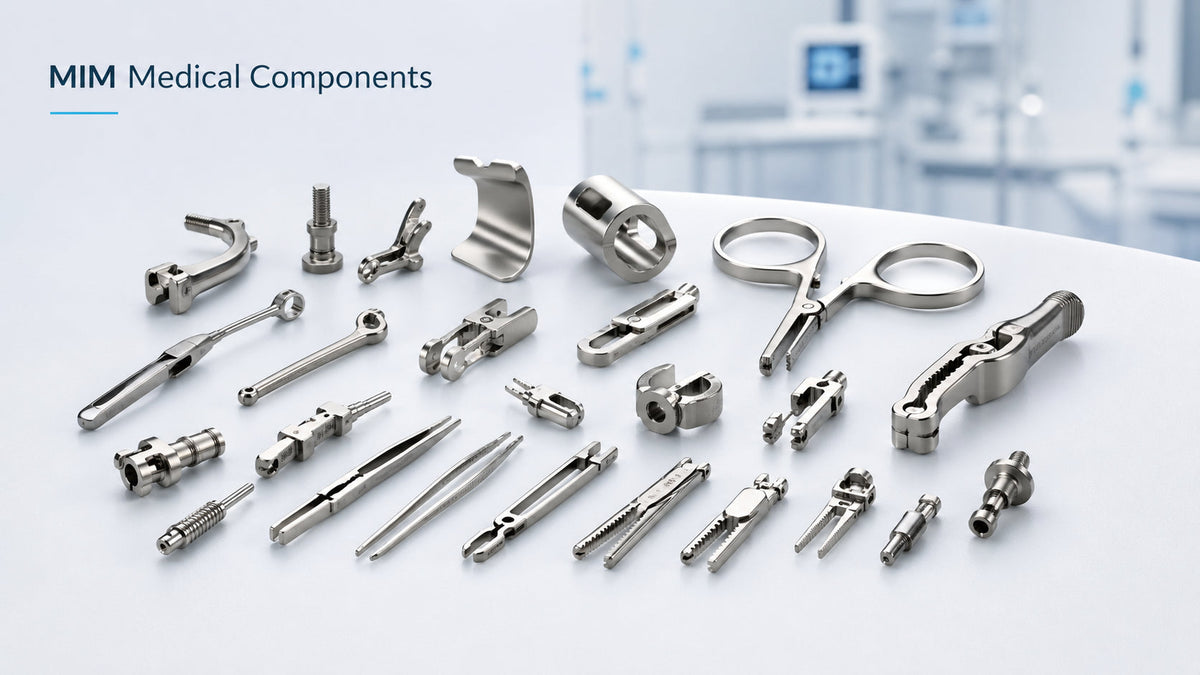
Aluminum is one of the most widely used metals in modern manufacturing. Its low density, good thermal conductivity, corrosion resistance, and machinability make it attractive for automotive components, electronic housings, aerospace parts, and precision mechanical products.
With these advantages, it seems reasonable to expect aluminum to be a natural candidate for Metal Injection Molding (MIM).
However, there is a technical problem.
Aluminum is considerably more difficult to process through metal injection molding than commonly used MIM materials such as stainless steel.
The main difficulty is not injecting aluminum powder into a mold. It is what happens afterward, particularly during sintering.
The oxide layer that naturally forms on aluminum powder particles makes it difficult for individual particles to bond together. This directly affects the density, strength, and reliability of the finished component.
Understanding this issue is important when evaluating aluminum MIM for a new product. It also helps engineers determine whether this manufacturing route is practical or whether another process would deliver better results.
1. Why Aluminum Powder Creates a Sintering Problem
The key challenge in aluminum metal injection molding comes from the material's natural tendency to oxidize.
When aluminum powder is exposed to oxygen, a thin aluminum oxide layer (Al₂O₃) forms on the particle surface. Although this layer is extremely thin, it is chemically stable and difficult to remove.
This becomes a serious problem during sintering.
In conventional MIM production, metal powder particles are heated to a controlled temperature so that atoms can diffuse across particle boundaries. Gradually, the particles bond together, pores shrink, and the component develops its final mechanical properties.
With aluminum powder, the oxide layer interferes with this process.
Instead of allowing clean metal-to-metal contact, the oxide film acts as a barrier between neighboring particles. It restricts atomic diffusion and makes effective bonding more difficult.
The result can include:
-
Incomplete particle bonding.
-
Residual porosity inside the component.
-
Lower-than-expected mechanical strength.
-
Reduced ductility.
-
Inconsistent density throughout the part.
This is why simply applying a conventional stainless steel MIM process to aluminum powder does not produce reliable results.
The material requires a different approach to powder preparation and sintering.

2. Why Increasing the Sintering Temperature Is Not a Simple Solution
A common assumption is that increasing the sintering temperature will help aluminum particles bond more effectively.
In practice, this is not a straightforward solution.
Aluminum has a relatively low melting point of approximately 660°C. Its oxide layer, however, remains stable at temperatures far above the melting point of the metal.
This creates a narrow processing window.
If the temperature is too low, particle bonding and densification may remain insufficient. If the temperature becomes too high, aluminum can approach its melting point, increasing the risk of dimensional instability and other processing defects.
The challenge is therefore to achieve sufficient densification without losing control of the component's geometry.
For manufacturers developing aluminum MIM components, temperature alone is not the answer. The entire sintering system needs to be considered.
This includes:
Powder characteristics
Particle size, particle shape, surface condition, and oxygen content all influence how aluminum powder behaves during processing. Powder with a high surface oxide content can make densification particularly difficult.
Sintering atmosphere
The furnace environment must be carefully controlled to limit additional oxidation and support the required metallurgical reactions. However, simply using an inert atmosphere does not automatically remove the oxide film that already exists on the powder.
Alloy composition
Different alloying elements can influence oxide behavior, liquid-phase formation, and particle bonding. Selecting an aluminum alloy for MIM therefore requires more than looking at its mechanical properties in conventional wrought or cast form.
These factors need to work together. A suitable temperature profile cannot compensate for poorly prepared powder or an unsuitable feedstock system.
3. How Manufacturers Can Improve Aluminum MIM Densification
Although aluminum MIM presents significant challenges, it is not an impossible manufacturing route.
Research into aluminum alloy metal injection molding has focused on improving the interaction between powder particles during sintering.
Several areas are particularly important.
Powder and Feedstock Preparation
The quality of the final component starts before injection molding.
Aluminum powder must have suitable particle characteristics and a controlled surface condition. The powder is then mixed with a carefully designed binder system to create a feedstock with consistent flow behavior.
If the powder and binder are not distributed uniformly, problems may appear during injection, debinding, or sintering.
For example, powder-binder separation can create local variations in metal concentration. After debinding and sintering, these differences may contribute to uneven shrinkage and internal defects.
For this reason, feedstock consistency is a fundamental requirement rather than simply a preparation step.

Controlled Debinding
After injection molding, the binder must be removed without damaging the fragile green component.
This stage requires particular attention because the component has not yet developed its final metal strength.
If the binder is removed too quickly, internal gas pressure can cause cracks, deformation, or other defects.
If binder removal is incomplete, residual carbon or other contaminants may interfere with subsequent sintering.
For aluminum MIM, debinding conditions must be developed alongside the powder and sintering system rather than treated as an independent operation.
Optimized Sintering Conditions
The objective of sintering is to improve particle bonding while minimizing residual porosity and dimensional distortion.
Researchers have investigated different alloy compositions, sintering atmospheres, and densification mechanisms to address the oxide barrier.
A 2025 study published in Materials Science and Engineering: A reported the production of highly dense 6061 aluminum alloy through metal injection molding, highlighting the importance of overcoming the oxide-related limitations.
This is an important development because it demonstrates that aluminum MIM can achieve promising material properties under appropriately developed processing conditions.
However, laboratory results should not automatically be interpreted as proof of established mass-production capability. Repeatability, production cost, dimensional consistency, and mechanical-property validation still need to be demonstrated for the specific component.
4. When Does Aluminum Metal Injection Molding Make Sense?
Solving the sintering problem is only part of the manufacturing decision.
Even if aluminum MIM is technically achievable, it does not mean it is automatically the most economical or practical process.
The application needs to justify the additional process development.
Aluminum MIM may be worth investigating when a component has:
-
Small dimensions and relatively complex geometry.
-
Features that would require multiple machining operations.
-
A high expected annual production volume.
-
A clear requirement for aluminum's low weight or thermal conductivity.
-
A design that can benefit from near-net-shape manufacturing.
On the other hand, aluminum CNC machining or die casting may be more appropriate for many conventional applications.
For example, if a component has relatively simple geometry and requires tight dimensional tolerances on several functional surfaces, CNC machining may offer a more predictable solution.
If the part is relatively large and production quantities are high, aluminum die casting may provide a more established manufacturing route.
The important point is to compare the complete manufacturing requirements, not just the material or the shape.
A process that looks attractive on paper may become expensive when additional heat treatment, machining, inspection, and process qualification are included.
5. Aluminum MIM vs. Conventional Aluminum Manufacturing
The following comparison helps illustrate where each process is more suitable.
| Manufacturing Process | Main Advantage | Main Consideration |
|---|---|---|
| Aluminum MIM | Complex, small-scale geometries | Challenging sintering and process development |
| CNC Machining | High dimensional accuracy and flexibility | Material waste and machining time |
| Aluminum Die Casting | Efficient production of complex aluminum parts | Tooling investment and casting-related defects |
| Aluminum Powder Metallurgy | Powder-based near-net-shape manufacturing | Geometry and density limitations depend on the process |
There is no universally best manufacturing method.
The right choice depends on component geometry, material properties, production volume, dimensional requirements, and total manufacturing cost.
For engineers evaluating aluminum MIM, these factors should be reviewed before investing in tooling or production development.

Conclusion
The biggest obstacle in metal injection molding aluminum is not the injection stage. It is achieving reliable particle bonding during sintering.
Aluminum's naturally occurring oxide layer makes densification difficult, while its relatively low melting point limits the available processing window.
This is why aluminum MIM requires carefully developed powder characteristics, feedstock formulations, debinding conditions, and sintering parameters.
Although research has demonstrated promising progress, aluminum MIM should still be evaluated carefully against more established manufacturing processes.
At MIM-Supplier, selecting the right manufacturing process starts with understanding the actual requirements of the component. Geometry, material performance, production volume, and dimensional expectations all need to be considered together.
If you are developing a precision metal component, discussing the manufacturing route at the design stage can help avoid unnecessary tooling costs and production difficulties.
Contact MIM-Supplier to discuss your component design and explore a suitable manufacturing solution.
Compartir:
Ceramic Injection Moulding Process: How CIM Turns Ceramic Powder into Precision Components